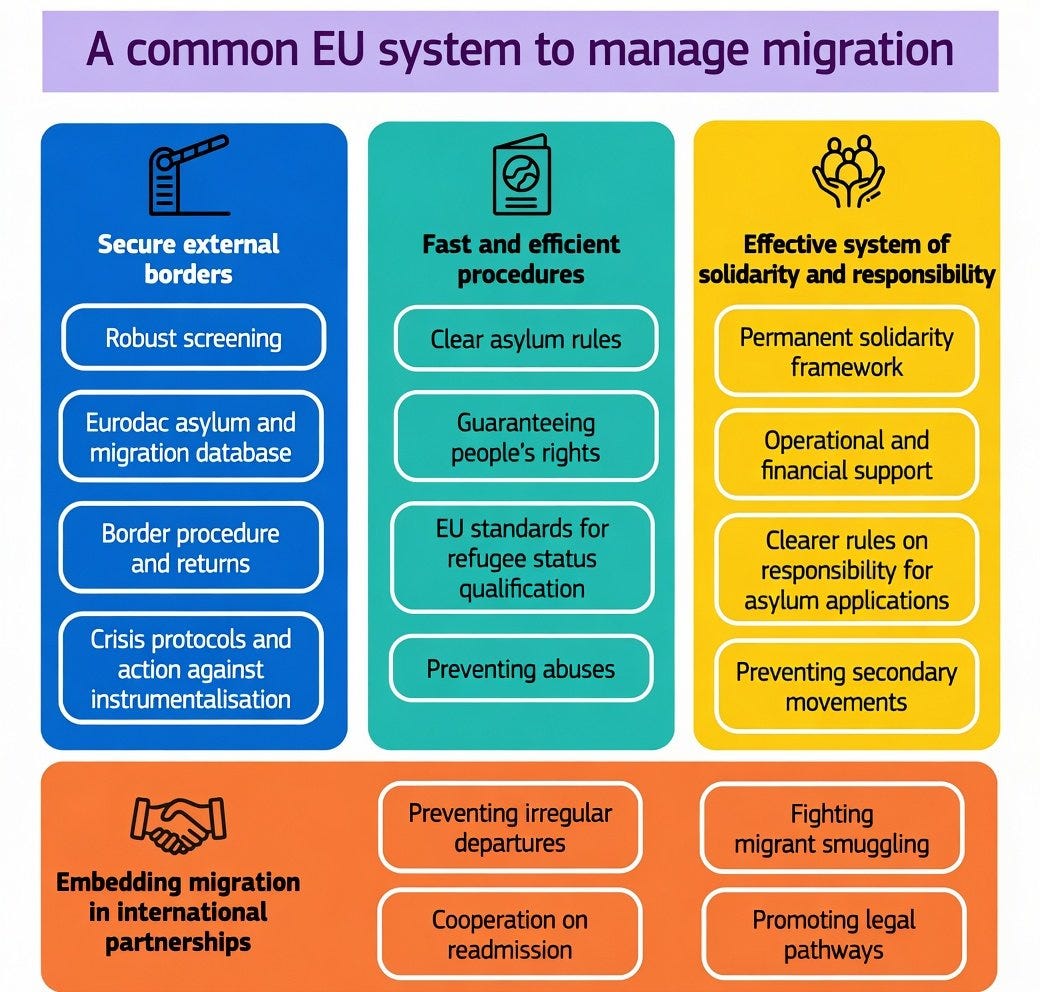
The EU Migration Pact
Architecture of a New System of International Migration

The EU Pact on Migration and Asylum, entered into force on June 12, is a historic step for the EU because it overcomes the post-2015 divisions (Syrian crisis) and creates a harmonized supranational system for 27 countries, instead of leaving everything to individual states (as under the old Dublin system).
There is a lot of discussion about immigration and this legislation will very likely be the basis of EU member states’ immigration regulation and management over at least the next decade, more or less regardless of who people elect. So I was surprised by how little it was discussed.
Here we are mostly interested in saying what can be said on the basis of facts, but I’ll introduce some political considerations here and there.
First of all, the pact has an External dimension, concerning EU borders and relations with countries of origin, and an Internal one, concerning relations among EU countries, solidarity, and the harmonization of rules.
1) External
A) Security of the external borders:
To address the problem of irregular immigration, which includes individuals who enter with temporary visas and remain beyond their expiration date, disappear, do not proceed through legal channels, or arrive following SAR operations, etc., the Screening Regulation enters into force. It will require all those who enter the EU irregularly (or after SAR operations) to undergo a mandatory screening that includes identification, fingerprinting, security checks, health checks, vulnerability assessments, and document fraud detection.
The data will be channelled into the Eurodac database, which will be something of a Big Brother of EU immigration, recording fingerprints, facial images, and biometric data for asylum seekers and irregular migrants.
All of this is intended to “channel” the person into the appropriate procedure (asylum, return, or other) and make their status uniformly verifiable across the Union.
Following the Screening, there will be two main tracks: the ordinary procedure (longer) and the border procedure.
The Border Procedure (a mandatory border procedure regulated by the Asylum Procedures Regulation and the Return Border Procedure) applies to those with a low probability of receiving protection (e.g. nationalities with a recognition rate below 20–30%), as well as those who provide false information or pose a security risk.
After screening, these individuals do not formally enter EU territory (”fiction of non-entry”), are hosted in facilities near the border [see the Italy-Albania case], and will receive either asylum or a return decision within 12 weeks through a single integrated process. The purpose is to make rapid decisions and obtain swift returns before individuals evade the control of the authorities, whereas previously these processes could take years.
Part of this is actually enabled by a separate text, the EU Returns Regulation, approved five days after the EU Pact on Migration and Asylum, which introduces the possibility of “return hubs” in third countries, a measure supported by ECR/Meloni to make the return centres in Albania operational, which so far have been a disaster (also) due to unclear regulations.
B) Cooperation with third countries (origin and transit)
Here the EU is pursuing a “carrot and stick” strategy. On the one hand, it demands greater cooperation in preventing irregular departures, combating smugglers, and improving returns and readmissions; on the other, it offers more and better-organized legal pathways and training opportunities (as well as investments, through initiatives such as the EU Global Gateway).
Legal pathways are designed to manage legal immigration in an orderly manner, while addressing labour shortages in the EU. These will be implemented and harmonized through two instruments: Talent Partnerships and the EU Talent Pool.
A) Talent Partnerships (TPs) are bilateral/multilateral agreements between the EU and third countries aimed at providing the EU with more trained workers in sectors experiencing labour shortages (regardless of skill level), while offering partner countries training opportunities and facilitated mobility pathways. Current partner countries include Morocco, Tunisia, Egypt, Pakistan, and Bangladesh. The partnerships are “tailor-made”: priority sectors are defined for each country through annual roundtables.
Before moving on to the EU Talent Pool, perhaps the most original part of the package, allow me a brief digression to provide some context for the EU Talent Partnerships.
The partnership model is based on THAMM, a European initiative launched with Germany in 2019 to train North African workers (Morocco, Algeria, Tunisia, Egypt) before migration. The success of the project led to THAMM Plus (2024), the true precursor of both the Talent Partnerships and the EU Talent Pool, which now, in addition to Germany, includes France, Italy, Spain, Portugal, Sweden, and Belgium (65% of the EU population and 70% of its GDP).
A pilot programme was launched in Italy in 2025, driven by labour demand from industries in Lombardia, Veneto, and Emilia-Romagna (3 of the top 10 EU regions by manufacturing value added), an initiative that Prime Minister Meloni sees as part of the broader Mattei Plan, the strategic diplomacy, development cooperation, and investment programme launched by the Italian government in January 2024 to redefine relations between Italy and the African continent.
The Mattei Plan itself, initially promoted as a national programme, is now increasingly taking shape as the operational model for implementing the European strategy in Africa and, more broadly, in emerging markets, including in the field of migration.
Over the last three years, Von der Leyen has undertaken a series of highly symbolic actions which, politically speaking, signal the European Commission’s alignment with ECR positions (and particularly those of Meloni) on immigration. In policy terms, they point toward what could be described as an ambitious Globalization 2.0 with European characteristics.
In 2023, she travelled to Tunisia with Meloni to sign the EU–Tunisia memorandum aimed at externalizing border management and controlling migration flows across the Mediterranean, followed by broader agreements with Egypt, Lebanon, Mauritania, and Morocco. She then attended the Italy–Africa Summit (2024) in the Italian Senate alongside Giorgia Meloni to support the Mattei Plan and cooperation strategies with countries of origin. The following year, she hosted a summit at Villa Pamphili in Rome focused on migration management, with particular emphasis on the stabilization of Libya, the main source of irregular migration flows, notoriously under the control of military forces linked to Russia, whose influence in the region has been recently weakened by its domestic war effort.
Alongside this latter initiative came the funding. On June 20 2025, Von der Leyen and Meloni co-chaired the official summit on the Mattei Plan and the EU Global Gateway, formalizing the integration of the EU’s large-scale investment programme, which includes €150 billion for Africa, with the Mattei Plan, effectively merging strategies related to major infrastructure investments, industrial offshoring, trade, skills development, and migration flows.
B) Here enters the EU Talent Pool, the EU digital platform (fully operational from 2027) that connects European employers with candidates from third countries, expanding the domestic labour market to a potentially immense pool of workers.
While THAMM focused on specific bilateral migration corridors, the EU Talent Pool extends the same logic of “safe and circular migration” by creating the first centralized and standardized European platform for all third countries.
Its explicit objective is to help European companies fill labour shortages in critical sectors through regular immigration. Participation by EU member states is voluntary (the Commission expects between 11 and 20 countries to join during the first three years).
EU Talent Pool works as follows:
Candidates (Jobseekers) register on the platform and create a detailed profile including skills, qualifications, work experience, language proficiency, and other relevant information. They can indicate participation in TPs programmes, which provides a priority pathway. The platform displays job vacancies published by EU countries, encouraging applicants to target the occupations most in demand at a given time.
Employers publish their vacancies (primarily in shortage occupations; member states may add or remove occupations to reflect national needs), access candidate profiles, and contact applicants directly for interviews. Most positions are expected to be low- to medium-skilled, particularly in healthcare, construction, transport, hospitality and elderly care, agriculture, manufacturing technicians, and various types of IT specialists. However, the system remains highly adaptable, as member states can continuously add or remove sectors.
The platform facilitates matching between labour supply and demand, but it is not a direct application portal and does not replace visa or residence permit procedures. Following a successful match, candidates must still complete national immigration procedures, although they are obviously in a much stronger position by already having a job offer before arrival.
This also aligns with the EU Legal Gateway Offices (currently being piloted with 🇮🇳India since February 2026), one-stop shops established by the EU in partner countries to facilitate safe and legal migration and mobility towards all 27 member states.
In the Age of Digital Platforms, you can now effortlessly order your tailored immigrant on global markets more efficiently, smartly, seamlessly, and in real time. Meanwhile, Eurodac selects what’s best for you on the secondary market.
This architecture is interesting because, depending on how you look at it, and how it will ultimately be implemented, it could either be the XXI century slave trade under international law, or the first step toward the full globalization of capital, goods and services, and now labor markets, reducing borders to the perimeter within which strategic interests are synthesized at scale. Both interpretations probably hold some truth.
In any case, this is the future. Too many things have been built around this architecture for it to disappear overnight, which means that from now on this is the basis on which the debate will have to take place.
It is also the future because of a whole series of forces pushing Europe (and the world) in this direction, forces related to demography, technology, productivity dynamics, industrial competition, and international strategy. But it is also the future because the domestic component of the Pact on Migration and Asylum introduces a harmonization of internal regulations that makes non-participation particularly unattractive.
It is the classic Divide et Integra of our Eurocrats: create a solid deal among a group of countries surpassing a certain threshold of weight within the Union (see THAMM), generally involving a large number of reciprocal compromises across different sectors, and these countries then pull the others along, more or less rapidly, through network effects, because as the number of adopters increases, so do the incentives to adopt.
2) Internal
Although it is somewhat more technical and consists of a great deal of micromanagement, the internal dimension is no less important and is fully integrated with the external one. Here too, there are two main elements:
A) The Asylum Procedures Regulation (APR) establishes common rules for the entire asylum process, with defined maximum timeframes and accelerated procedures for manifestly unfounded or abusive claims. It guarantees minimum reception standards and rights, while limiting abuses and secondary movements.
The common asylum procedures are complemented by the Qualification Regulation, which establishes uniform EU standards for recognizing refugee status and subsidiary protection, and by the Reception Conditions Directive, which sets common standards for reception conditions (housing, assistance, access to employment).
This part essentially ensures that a refugee in Italy is treated in the same way as a refugee in France, and that their precise status is defined according to harmonized rules across the Union.
This facilitates a variety of operations, such as family reunification between member states and, more generally, agreements regarding the distribution of asylum seekers.
B) The Asylum and Migration Management Regulation (AMMR) replaces (and reforms) the old Dublin Regulation in order to improve solidarity and the sharing of responsibilities.
It includes clearer rules regarding which member state is responsible for an asylum application and introduces a mandatory but flexible solidarity mechanism: states under pressure (e.g. Italy, Greece, Spain) receive mandatory assistance from other member states.
Such assistance may take the form of: relocation of applicants, financial contributions (around €20,000 per person not relocated), operational support (personnel and capacity-building), or return sponsorships.
Alongside this, the Crisis and Force Majeure Regulation introduces the possibility of temporary derogations in the event of crises (mass arrivals or the instrumentalization of migration flows by third countries), allowing for longer procedural timeframes or extraordinary measures (albeit with various safeguards).
It is remarkable that this part of the text was accepted. These issues have been debated extensively across Europe over the last ten years, often in relation to aspects concerning only a very small fraction of total immigration, such as asylum seekers who escaped the control of authorities after disembarkation and occasionally moved to other countries, triggering grotesque reactions that at times seemed to put Schengen seriously at risk.
On the other hand, I do not believe that those who voted for ECR parties because they were concerned about ethnic replacement or multiculturalism, or because they wanted mass deportations, will obtain what they were hoping for.
It is important to note once again that Member States retain substantial autonomy even under full implementation of EU rules, since the issuance of legal visas, quotas, etc. remains in the hands of national embassies, and participation in the EU Talent Pool allows countries to adjust eligible sectors according to their needs. EU legislation is more of an enabler and an organizer than else, but it does indeed reflect the underlying interests of Member States.
In fact, it should be noted that many national legislations already make immigration significantly easier for people who arrive with verifiable training and qualifications. The leader of ECR Meloni provides an example: the Cutro Decree (2023) exempted individuals who complete work and training pathways approved by the Italian Ministry of Labour (which will include Talent Partnerships) from the quotas established by the Decrees regulating the admission of regular immigrants.
In conclusion, the likely results of this EU regulatory framework will be: lower irregular immigration (of all kinds); higher regular immigration (and therefore higher immigration overall); and higher labour-force participation rates among immigrants, particularly in formal employment.